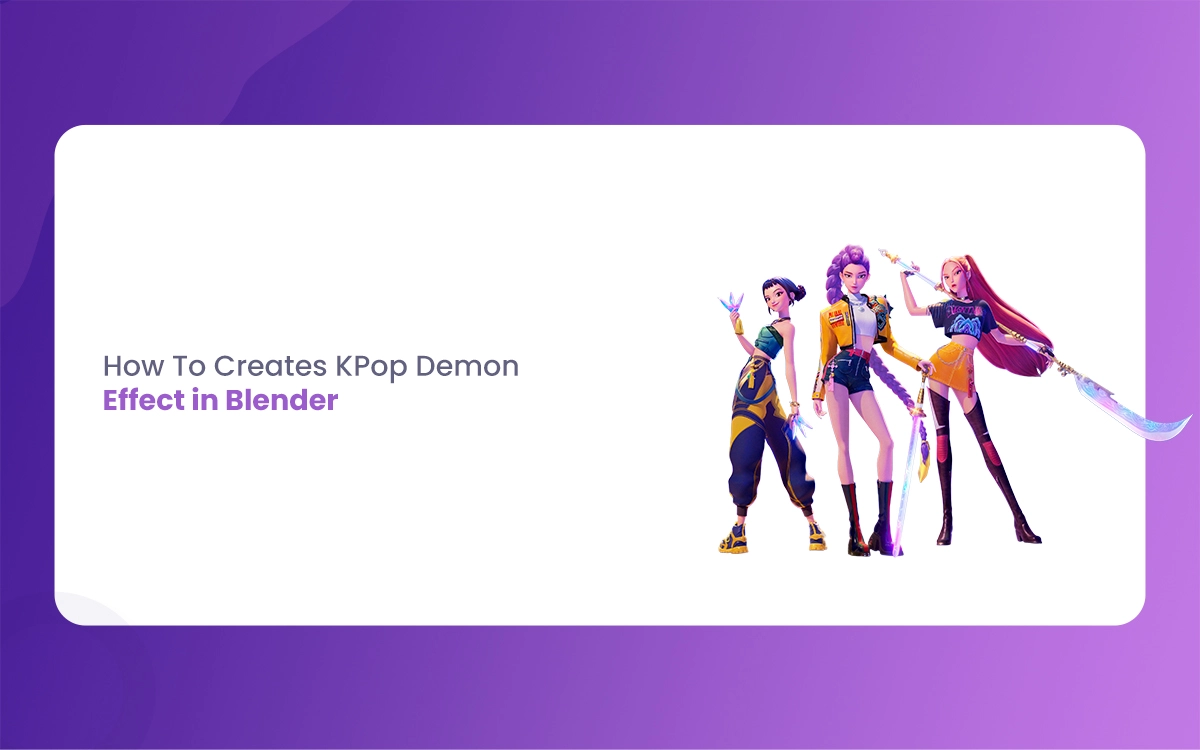
The supernatural action thriller ” KPop Demon Hunters Ramen ” has attracted and dazzled audiences with its stunning visual effects, particularly the ethereal, glowing weapon trails that follow the heroes’ enchanted blades. These energetic, sparkling effects—reminiscent of the film’s iconic gokdo (moon sword) sequences—have inspired statistical artists worldwide to recreate similar visuals using Blender’s powerful procedural tools.
Creating these mesmerizing weapon effects requires a combination of geometry nodes for trail generation and emission shaders for that signature otherworldly glow. Artists like Mqleh have pioneered techniques that make these effects accessible to intermediate Blender users. The Morphic Studio shares the information about the complete process of building a procedural sword trail with colorful sparkles, perfect for action sequences, game assets, or fan art projects.
Whether you’re a VFX artist looking to expand your skillset, a game developer needing energetic weapon effects, or simply a K-Pop Demon Hunters enthusiast wanting to bring that movie magic into your own projects, this tutorial will provide you with the foundational knowledge and practical steps to achieve professional-quality results.
Prerequisites and Project Setup
Before diving into the creation process, ensure you have Blender 3.0 or later installed, as this tutorial relies heavily on geometry nodes features introduced in recent versions. Familiarity with basic Blender navigation, the node editor, and keyframe animation will be helpful, though this guide provides detailed instructions for each step.
Start by opening a new Blender project and delete the default cube. Save your project with a descriptive name like “KPop_Weapon_Trail.blend” to avoid losing your work. Set your timeline to at least 120 frames to allow for a complete sword swing animation.
Step 1: Setup Model and Animation Empties
Preparing Your Weapon Model
The foundation of any weapon trail effect is, naturally, the weapon itself. You can either model a simple sword in Blender or import an existing 3D model. For this tutorial, a basic katana or fantasy blade works perfectly. If modeling from scratch, keep the geometry clean and ensure the blade has clear tip and base points.
Once your KPop Demon Hunters Ramen weapon is in the scene, you’ll need to animate a swinging motion. Select your sword and open the Timeline editor. At frame 1, press I to insert a rotation keyframe. Move to frame 60, rotate your sword approximately 180 degrees along its swing arc, and insert another rotation keyframe. For smoother motion, open the Graph Editor and set the interpolation to “Bezier” with easing.
Creating Tracking Empties
The trail system requires precise tracking of the blade’s movement, which we accomplish using Empty objects parented to specific vertices:
With your weapon selected, enter Edit Mode (Tab key)
Select the vertex at the base of your blade (near the hilt)
Press Shift+S and choose Cursor to Selected to move the 3D cursor to that vertex
Exit Edit Mode (Tab) and add an Empty: Add > Empty > Plain Axes
Name this Empty “Base_Tracker” in the Outliner
Repeat the process for the tip vertex, naming this Empty “Tip_Tracker”
Now comes the crucial parenting step that makes these Empties follow the blade:
In Object Mode, Shift-click to select “Base_Tracker” first, then your weapon
Press Ctrl+P and select Vertex from the parent menu
Repeat for “Tip_Tracker”
When you scrub through your animation timeline, both Empties should now perfectly follow their respective blade positions.
Step 2: Create Trail Geometry with Geometry Nodes
Setting Up the Node Tree
This is where the magic begins. We’ll use Blender’s geometry nodes to generate a procedural trail that follows your weapon’s motion through time:
Add a Plane object (Shift+A > Mesh > Plane)
Name it “Trail_Generator”
With it selected, switch to the Geometry Nodes workspace
Click New to create a geometry nodes modifier
Delete the default “Group Input” node connection to Group Output
The geometry output should remain, but with no input mesh
Building the Trail Node Groups
The trail system uses Blender’s Simulation Zone to store historical position data. Here’s how to construct it:
For the Base Tracker:
Drag your “Base_Tracker” Empty into the node tree (creates an Object Info node)
Set the Object Info to Relative transform
Add a Simulation Zone (Add > Simulation > Simulation Zone)
Inside the simulation, add Points node and connect Base_Tracker’s Location to Position
Add Join Geometry and connect both the Points and the Simulation Input
Add Store Named Attribute node, name it “age”, and set value to the previous age +1 (using a Math node in Add mode with the stored age)
Add Delete Geometry node with condition: age > 15 (adjust this value for trail length)
For the Tip Tracker: Repeat the exact same process for “Tip_Tracker,” creating a parallel simulation zone. You should now have two separate point clouds that record the historical positions of both blade ends.
Connecting Trails into Mesh
Now we’ll transform those point clouds into actual geometry:
Add Join Geometry to combine both point cloud outputs
Use Instance on Points with a subdivided plane
Add Sample Index nodes to get positions from both trackers by index
Use Vector Math (Subtract) to calculate the vector between corresponding points
Add Points to Vertices followed by Extrude Mesh using the calculated vector
For a smoother surface, add a Grid primitive (Y: 2 vertices, X: matching your point count) and use Sample Index to map trail positions onto the grid vertices. This creates a lofted surface between the two edge trails.
Refining the Mesh Quality
To achieve that sleek, sharp-tipped trail look:
Add Subdivide Surface modifier (magnitudes: 2-3 for smoothness)
Use Set Vertex Crease on the leading edge (index == edge count -1, domain: Edge, crease value: 1.0) to maintain a sharp tip while keeping sides smooth
Step 3: Add Gradient and UV Attributes
For proper fading effects and texture mapping, we need to store additional data:
After creating your point clouds, add Points to Curves to one trail
Use Spline Parameter node to generate a 0-to-1 gradient along the trail
Store Named Attribute called “grad” with this parameter value
Transfer this “grad” attribute to your final mesh using Sample Index
Similarly, create and store a UV map using the Grid primitive’s UV data
These attributes will drive the color gradient and any procedural textures in the shader.
KPop Demon Hunters Ramen
Step 4: Shader for Glow and Sparkles
Creating the Base Emission Shader
Select your trail geometry and create a new material:
Enable Shade Smooth on the geometry
In the Shader Editor, add an Attribute node, set to “grad”
Add RGB Curves to boost emission brightness selectively
For colored glow, add Color Balance with slight tint toward purples/magentas
Fine-Tuning Trail Behavior
Adjust these parameters for different effects:
Trail lifetime (age threshold): 10-12 for short, snappy trails; 20-30 for long, flowing ribbons
Animation speed: Faster swings need shorter trails to avoid clutter
Emission strength: 5-8 for subtle; 12-20 for dramatic supernatural effects
Subdivision magnitudes: 2 for performance; 4 for glass-smooth surfaces
Technical Specifications Table
Parameter
Suggested Value
Purpose
Performance Impact
Trail Age Limit
15-20 frames
Controls trail length behind weapon
Medium – affects point count
Subdivision Magnitude
2-3
Smoothness of trail surface
High – quadruples geometry per magnitude
Emission Strength
8-15
Glow intensity
Low – shader only
Noise Scale Y
15-20
Vertical sparkle streak length
Low – texture calculation
Bloom Threshold
0.7-0.9
Controls what emits bloom glow
Medium – post-process effect
Bloom Radius
5-8
Size of glow halo
Medium – post-process effect
Simulation Points
100-200
Trail resolution/smoothness
High – affects simulation speed
ColorRamp Stops
3-5
Color transition complexity
Low – shader only
Grid Subdivisions X
Match point count
Trail width resolution
Medium – affects vertex count
Grid Subdivisions Y
2-4
Trail cross-section detail
Low – minimal geometry impact
Render Samples (Cycles)
128-256
Final image quality
Very High – render time
Vertex Crease Value
0.8-1.0
Sharpness of trail tip
None – subdivision parameter
Troubleshooting Common Issues
Trail appears broken or disconnected: Ensure both Empties are properly parented to vertices using Vertex parent mode, not Object mode. Check that your weapon animation doesn’t have sudden teleportation jumps.
No glow visible: Verify emission strength is above 5.0 and that Bloom is enabled in Eevee or you’re using sufficient samples in Cycles. Check that your camera isn’t inside the trail geometry.
Trail too short or too long: Adjust the age threshold in your Delete Geometry node. Lower values create shorter trails; higher values create longer ones.
Performance issues during playback: Reduce subdivision magnitudes, decrease maximum trail age, or lower simulation point count. Consider using Eevee instead of Cycles for viewport playback.
Sparkles not visible: Increase contrast in the ColorRamp connected to your noise texture. Ensure UV mapping is properly stored and retrieved via Named Attributes.
Finally
Creating KPop Demon Hunters Ramen-inspired weapon effects in Blender combines technical precision with artistic flair. Through procedural geometry nodes, you’ve learned to generate energetic trails that follow weapon motion, while emission shaders and post-processing bring the supernatural glow to life. The modular nature of this setup allows endless customization—experiment with different colors for elemental themes, adjust trail persistence for different weapon types, or incorporate additional particle systems to create unique magical signatures.
This technique scales from simple fan art to production-quality game assets and VFX shots. As you become comfortable with the fundamentals, consider exploring advanced variations: multiple trail colors fading through gradients, reactive trails that change based on swing speed, or integration with physics simulations for cloth-like ribbon effects.
The procedural approach ensures your effects remain editable and adaptable. You can animate trail parameters with keyframes, create presets for different weapon types, or even drive the effect intensity through drivers linked to audio amplitude for music-synchronized combat sequences worthy of the K-Pop Demon Hunters themselves.
Think of the best visual effects that balance technical execution with artistic intent. Study reference footage from the film, observe how light interacts with motion, and don’t be afraid to push the parameters beyond realism into stylized territory. The supernatural demands spectacle, and Blender’s tools give you the power to deliver exactly that. Now go forth and create weapon trails that would make even the most seasoned demon hunter envious.
Related Article
March 23, 2026
How To Create Hot Cartoon Moms Using Adobe Character Animator? (Education Guide)
Welcome to The Morphic Studio! If you are here, you probably want to learn how to bring stylish, attractive, and memorable characters to life. Designing “moms” in animation has changed a lot over the years. We have moved from simple background characters to icons like Elastigirl or Dexter’s Mom. Today, we are diving deep into […]
March 20, 2026
Adobe Character Animator: Master 5 Effortless Animation Tricks
Ever look at a cartoon and think, “I wish I could do that,” but feel overwhelmed by drawing every frame? You are not alone. Animation used to be this scary, mountain-high task that required years of training and a lot of patience. But things have changed. With Adobe Character Animator, the game has shifted from […]
March 20, 2026
Cartoon Animator 5: 2D Animation Software for Cartoon Makers
Hello everyone, and welcome back to The Morphic Studio. Today, I am super excited to talk about a software that has completely changed how we look at statistical art. If you have been searching for a reliable way to bring your drawings to life, you are absolutely in the right place. We are going to […]