There are a few anime franchises that have managed to turn typography into a battle weapon, but JoJo Bizarre VFX Adventure is proudly one of them. Created by Hirohiko Araki and adapted into anime by David Production, JoJo has carved out a singular identity in animation history, not just through its flamboyant poses or supernatural Stand battles, but through the sheer visual ferocity of its sound effects. The onomatopoeia in JoJo isn’t simply text slapped onto a frame; it’s a living, breathing component of the visual storytelling, as dramatically rendered as any punch or energy beam.
For VFX artists, animators, and motion graphics designers, following the anatomy of JoJo Bizarre VFX onomatopoeia system opens a creative goldmine. Whether you’re compositing fan animations in After Effects, rigging text emitters in Blender, or simply trying to recreate that unmistakable JoJo attractiveness, the morphic studio shares insights into the franchise’s iconic sound language and how it translates into modern VFX workflows.
What Is Onomatopoeia in the Context of JoJo’s Bizarre Adventure?
Onomatopoeia, in Japanese linguistic tradition, is divided into two primary categories: giongo, which describes sounds produced by inanimate objects or natural phenomena, and giseigo, which captures sounds associated with living beings, emotions, physical sensations, or bodily actions. JoJo’s Bizarre Adventure weaponizes both categories with extraordinary creativity, often inventing entirely new phonetic constructions that don’t exist in standard Japanese dictionaries.
What separates JoJo’s approach from other shonen titles is Araki’s insistence on using sound effects as a narrative device rather than a purely functional one. When the ominous purple letters of ゴゴゴゴ (Gogogogo) rise behind a villain, you don’t just hear tension, you feel it pressing down on you like gravity. When ORA ORA ORA floods the screen during one of Jotaro Kujo’s signature Star Platinum rushes, the repeating text becomes a visual rhythm, syncing the viewer’s heartbeat to the animation’s momentum.
This philosophy carried seamlessly into the anime adaptation, where David Production’s VFX team raised the manga’s flat typography into fully animated, three-dimensional overlays that glow, distort, shatter, and pulse in sync with musical cues and character movement.
JoJo Bizarre VFX
Breaking Down the Core JoJo Onomatopoeia
Follow the most frequently appearing sound effects is essential before attempting to recreate them in any VFX environment. Each one carries a distinct visual personality that should inform how you animate, color, and distort it.
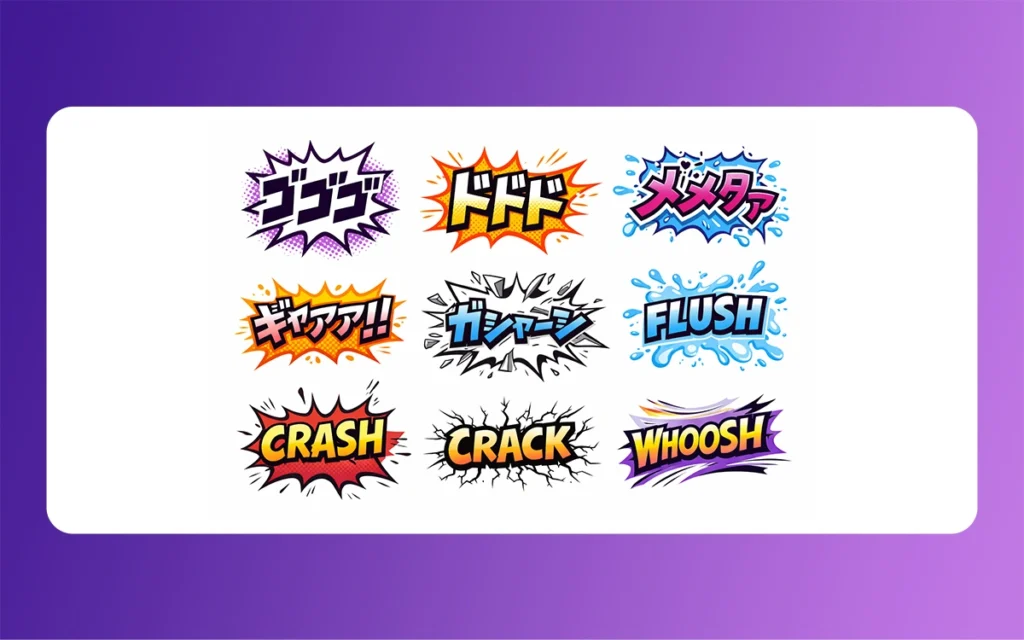
ゴゴゴゴ, Gogogogo
This is arguably the most iconic piece of JoJo typography. Gogogogo represents ominous buildup, the creeping, menacing aura that radiates from a powerful Stand user or villain before any attack is even launched. Visually in the anime, it appears in deep purples and blacks, often radiating outward from a character’s silhouette in diagonal stacks. The letters feel heavy, geological, like tectonic plates grinding against each other. For VFX artists, this effect works best with a slow radial expansion, slight chromatic aberration on the edges, and a low-frequency rumble synced to the font’s entrance animation.
ドドドド, Dodododo
Where Gogogogo implies threat, Dodododo signals action already in motion. This sound effect accompanies rapid movement, charging attacks, or overwhelming offensive rushes. Its visual treatment in the anime is more kinetic, the letters often appear streaked horizontally with motion blur, suggesting speed and forward momentum. The color palette tends toward reds and oranges when tied to aggressive attacks. For compositing, layering this over a fast-moving character with velocity-matched blur creates a deeply authentic result.
メメタァ, Memetaa
This one is unique to JoJo’s universe and has no real-world phonetic equivalent outside of Araki’s imagination. Memetaa typically accompanies facial contortions, extreme physical strain, or exaggerated impact reactions, the kind of expression you get when someone’s face is being stretched across an impossible amount of force. The typography for this effect tends to be irregular, with letters that appear squeezed, warped, or elastically distorted. Recreating it statistically means embracing mesh warp tools and non-uniform scaling on individual letterforms.
ズキュゥゥゥン, Zukyuuun
One of the most satisfying sound effects in the entire franchise, Zukyuuun captures the sensation of a piercing, explosive impact, a Stand ability cutting through the air or a bullet-speed punch connecting with bone-crunching force. In animation, it’s treated with sharp angular geometry, often rendered in electric blues or whites with a radiating light burst at the point of impact. It’s the kind of effect that deserves a full lens flare pass and a particle system emitting shards outward from the word’s center.
グッパオン, Geppaon
Less frequently cited but equally distinctive, Geppaon describes slashing or whipping motions, the sound of something cutting through air at velocity. Its visual treatment is more elongated, with letters arranged along a curved or diagonal axis to suggest directional momentum. This is the onomatopoeia you’d animate with a trail effect and a slight arc, timing each letterform’s entrance to a fraction of a second apart to create the illusion of motion cutting across the frame.
The VFX Onomatopoeia Reference Table
The following table serves as a practical reference sheet for artists working to recreate JoJo-style visual effects, cataloging each major sound effect alongside its meaning, visual characteristics, and recommended VFX treatment.
One important clarification for anyone researching this topic is that no officially published VFX onomatopoeia sheet has been released publicly by David Production, the studio responsible for the anime adaptation. What exists in public-facing archives are partial model sheet references, primarily circulating through fan communities and archival sites, covering Stand design poses and environmental VFX references for specific parts, including the Stone Ocean adaptation and portions of Diamond is Unbreakable.
The fan community has responded to this gap with impressive thoroughness. Style guides and recreation sheets have been assembled by dedicated artists who frame-by-frame analyzed the anime to extract typography guidelines, font mass, kerning logic, rotation conventions, and color grading approaches. These resources, shared across fan wikis and animation communities, have become the de facto standard reference material for anyone compositing JoJo-style VFX outside of the official production pipeline.
For professional VFX artists and students, the lesson here is valuable: even without official documentation, rigorous visual analysis of the source material can yield a functional style guide. The JoJo Wiki and associated fandom archives remain the most complete public repositories for this research.
Applying JoJo Onomatopoeia in Modern VFX Software
After Effects: Text Distortion and Motion Sync
After Effects remains the most accessible tool for recreating JoJo-style onomatopoeia overlays. The workflow typically begins with establishing the typeface, bold, high-contrast Japanese fonts with strong stroke mass are essential. From there, applying the CC Bend It or Mesh Warp effect to individual text layers allows you to achieve the organic distortion characteristic of effects like Memetaa.
For Stand rush sequences, the basic is rhythmic repetition. Duplicating text layers offset by two to three frames each, with a glow effect and slight scale pulse applied per duplicate, creates the visual stutter effect that makes ORA ORA ORA so visually overwhelming. Timing these pulses to the audio track’s percussion hits makes the effect feel genuinely integrated rather than cosmetic.
Blender and Cinema 4D: 3D Text Emitters
For three-dimensional fan animations, Blender offers powerful geometry node workflows that allow text objects to be used as particle emitters, spawning letter instances along a force field or along the path of an animated character’s punch trajectory. Basicframing text visibility to sync with impact frames, even a single-frame advance before the hit registers, adds a sense of physical causality that raises amateur work considerably.
Cinema 4D users benefit from MoGraph’s effectors, which can drive per-character animation with extraordinary precision. The Delay effector in particular is useful for the cascading entrance of Gogogogo-style stacked text, where each letter arrives with a slight temporal offset that sells the sense of mass and inevitability.
Typography Principles Behind the Attractive
The visual impact of JoJo’s onomatopoeia isn’t accidental, it reflects deliberate typographic decisions rooted in Araki’s manga origins. Several principles are worth internalizing for any artist attempting to work in this style.
Scale contrast is foundational. The most impactful sound effects in JoJo use extreme differences in letter size, sometimes within the same word, to direct the eye and imply force vectors. Italicization is almost universal for kinetic effects, with forward lean suggesting acceleration and backward lean (used more rarely) suggesting recoil or reversal. Stroke mass is always high, thin, delicate fonts read as weak in this attractive context, while heavy, almost brutalist letterforms carry the necessary visual mass.
Color grading, perhaps counterintuitively, should always feel slightly oversaturated relative to the background scene. The onomatopoeia exists in a heightened visual register above the diegetic world of the animation, and its color values should reflect that, slightly more luminous, slightly more chromatically intense, as if it exists in a different layer of reality.
JoJo Bizarre VFX
The Art of Making Sound Visible
JoJo Bizarre VFX Adventure has achieved something genuinely rare in visual media: it has made typography a form of choreography. The onomatopoeia system developed across Araki’s manga and refined in David Production’s anime adaptation constitutes a complete visual language, in which sound effects carry emotional weight, convey narrative information, and simultaneously convey an attractive identity.
For VFX artists and animators, engaging seriously with this system means more than copying a style. It means that every Gogogogo stacked behind a villain, every Zukyuuun radiating from a Stand impact, every ORA ORA ORA flooding a frame is a deliberate communicative act. Mastering the underlying principles, timing, mass, colour temperature, and distortion logic allows you not just to replicate JoJo’s attractiveness but to extend it with genuine creative intelligence.
Whether you’re building fan animations, studying motion graphics principles, or simply appreciating one of anime’s most distinctive visual traditions, the JoJo onomatopoeia sheet is a masterclass in the idea that, in the right hands, even a sound effect can be extraordinary.
Related Article
April 8, 2026
Game Art Outsourcing: Top 7 Benefits for Studios & Developers
In the fast-paced world of game development, staying ahead of the curve isn’t just about having the best ideas; it’s about how fast and effectively you can bring those ideas to life. If you have spent any time in a dev studio lately, you know the pressure is real. Players in 2026 expect cinematic quality, […]
April 8, 2026
How To Create Tall Cartoon Characters Using Adobe Character Animator? (Education Guide)
Animation design combines art and logic, especially when it comes to your cast’s proportions. If you want to make a character stand out, literally, making them tall is a classic move. Whether it is a lanky basketball player, a towering giant, or a slender fashion icon, Tall Cartoon Characters bring a unique dynamic to any […]
April 7, 2026
How To Create Cartoon Characters with Big Lips Using Adobe Character Animator? (Education Guide)
Welcome back to The Morphic Studio! Ever wondered why some cartoon faces “pop” more than others? Designing unique features is what makes a character memorable. Today, we are diving deep into a specific attractive choice that adds tons of personality and expression: Cartoon Characters with Big Lips. In 2D animation, the mouth is the window […]