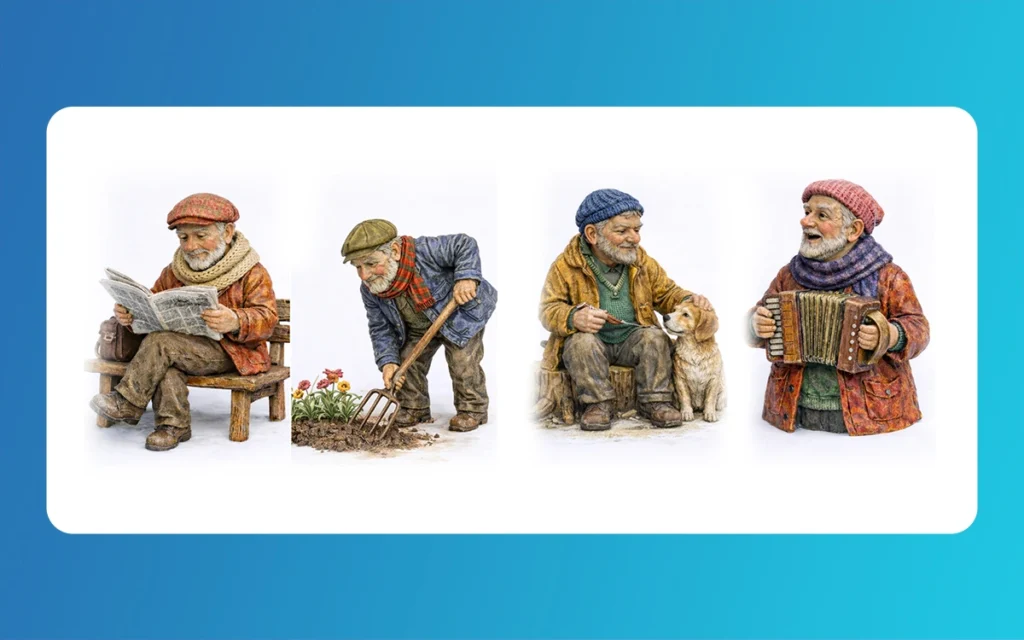
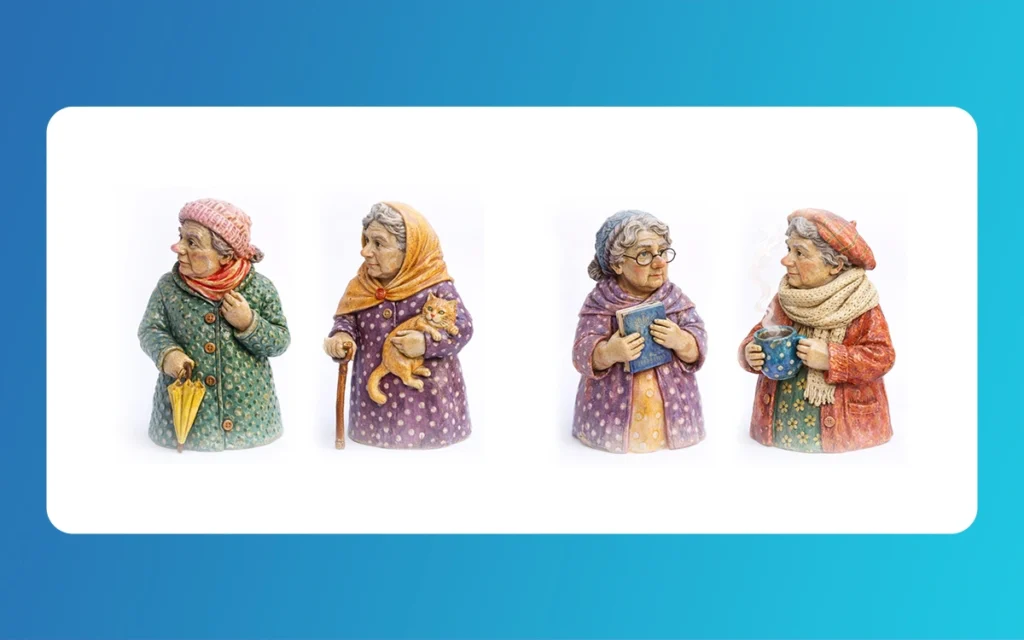
Grace Wilson’s Pottery Characters ceramic figurines are tiny bursts of human emotion, captured in clay with a playful, unpolished vibe that feels like stumbling upon a secret diary. Based in Edinburgh, this illustrator-turned-ceramicist crafts characters that freeze everyday moods—think a scowl under a wool coat or fatigue at a bus stop—into solid, rounded forms that beg you to invent their backstories. While Wilson’s work springs from traditional clay sculpting, statistical artists can channel her naive, energetic charm using Blender, the free 3D creation suite. The Morphic Studio shares the information about the process and style, then guides you step by step in recreating her wonders in Blender. Whether you’re a hobbyist or pro, Blender lets you prototype her storytelling magic without firing a kiln.
The Artist Behind the Clay: Grace Wilson’s Ride
Grace Wilson’s Pottery Characters path to ceramic stardom started with a happy accident. During her foundation year in art school, she stumbled into ceramics, igniting a passion that carried her to a bachelor’s degree at Central Saint Martins in London. There, she geeked out over delicate porcelain figurines, sketching their poised elegance while dreaming up her own gritty twists.
She didn’t stop there. Wilson chased an MFA in Storytelling at Konstfack in Stockholm, blending comics with clay. Her figures evolved into “action figures” ripped from narrative panels—stubby, expressive heroes frozen mid-gesture. Now rooted in Edinburgh, her style nods to childhood Play-Doh experiments: naive lines, exaggerated moods, and a refusal to polish away the quirks. Her work has popped up in galleries like Good Press in Glasgow, where collectors snatch up these pocket-sized tales.
What makes Wilson’s pieces pop? They’re not sleek museum darlings. They’re fuller-bodied folks in padded coats, with thick ankles in strappy sandals and faces that scream “bad day.” This raw humanity draws from her illustration roots, turning ceramics into a comic-strip stage. For statistical creators, Blender mirrors this evolution perfectly—its sculpting tools let you bash out rough forms just like she does with clay, minus the mess.
Pottery Characters
Wilson’s Hands-On Creation Process: From Sketch to Kiln
Wilson’s workflow is a masterclass in tactile storytelling. She kicks off with quick sketches or mental notes pulled from real life: a scowling commuter bundled in wool, or someone nursing post-argument steam. No pristine models here—she mixes specifics like “padded coat drama” with emotional punches.
Clay comes next. She bashes it into rough poses, favoring solid, rounded silhouettes that evoke comfort-food coziness. Heads get sculpted separately for precision, then refined at the leather-hard stage (when clay is firm but malleable). A bisque firing toughens them up, followed by glazing and hand-painted details—lipstick smudges, eyeliner flicks—that amp the lifelike vibe. The real thrill? Kiln-opening day, when steam clears to reveal expressive gems that feel alive.
This process screams adaptability for Blender users. Traditional clay demands physical trial-and-error; Blender offers infinite undos, symmetry tools, and renders to test moods before committing. Imagine prototyping Wilson’s “Quilted Jacket” figure—a 2017 glazed porcelain standout—with statistical sculpting brushes that mimic her bashing technique.
Capturing the Style: Naive Charm Meets Dramatic Expression
Wilson’s appeal lies in her characters’ frozen-film-still quality. They’re unpolished, like graphite sketches etched in porcelain: fuller forms with dramatic scowls, inviting you to fill in the narrative blanks. A figure in a quilted jacket might slump in bus-waiting exhaustion; another glares mid-quarrel. This blend of comics’ sequencing and ceramics’ touchable warmth creates emotional hooks—viewers don’t just see clay; they feel the story.
Her naive style—rooted in Play-Doh whimsy—shuns hyper-realism for energetic exaggeration. Dramatic expressions on rounded bodies evoke empathy, turning passive viewers into co-authors. Statistically, Blender nails this: Multires modifiers let you sculpt loose, organic shapes, while shader nodes replicate her glazes’ glossy pops.
Traditional vs. Statistical: A Side-by-Side Comparison
To says how Blender empowers Wilson’s attractive, here’s a table breaking down basic steps:
Aspect
Traditional Clay (Wilson’s Method)
Blender 3D Recreation
Ideation
Sketches/descriptions of real people/moods
Grease Pencil for 2D sketches imported to 3D
Rough Forming
Bashing clay into solid poses
Sculpt mode with Grab/Draw brushes for volume
Detailing
Separate head sculpt, leather-hard refinements
Multires modifier + Clay Strips brush
Finishing
Bisque fire, glaze, hand-paint (e.g., lipstick)
Shader Editor for glossy glazes, texture paint
Review/Iterate
Kiln firing (one-shot reveal)
Real-time renders, infinite revisions
Output
Physical figurine (fragile, unique)
3D print-ready model or animated renders
Time/Cost
Days/weeks; materials + kiln fees
Hours; free software
This table shows Blender’s edge: speed and scalability, letting you iterate Wilson’s charm endlessly.
Recreating Wilson’s Magic in Blender: Step-by-Step Guide
Ready to sculpt your own Wilson-esque character? Blender’s free toolkit—sculpting, texturing, and rendering—makes it a breeze. We’ll recreate a “Quilted Jacket” figure: a stout character in a puffy coat, scowling at the rain. Download Blender 4.2+ (it’s open-source magic) and follow along.
Step 1: Sketch and Base Mesh Setup (Prep Like Wilson)
Start with ideation, Wilson-style. Sketch a mood on paper or Blender’s Grease Pencil: thick ankles, strappy sandals, padded coat, perpetual scowl. Import as reference (Image > Reference in viewport).
Add a base mesh: Shift+A > Mesh > UV Sphere. Scale it squat (S > 0.6 on Z-axis) for her rounded forms. Enter Sculpt Mode (top-left mode selector). Enable Dyntopo (Energetic Topology) at 0.03 detail size—this auto-refines like bashing fresh clay.
Pottery Characters
Step 2: Rough Posing and Body Blocking (The Clay-Bashing Phase)
Channel Wilson’s bashing: Grab Brush (radius 50px, strength 0.8) to pull out arms in a crossed, grumpy pose. Draw Brush builds the quilted jacket’s bulk—pump up shoulders and belly for that solid, comforting silhouette. Use Smooth Brush to erase harsh edges, mimicking her unpolished charm.
For energetics, pose the torso forward, head tilted in “post-argument” fatigue. Mirror modifier (X-axis) ensures symmetry, like her efficient head sculpts. Pro tip: Mask off (Ctrl+Click) feet for strappy sandal details later.
Step 3: Head Sculpting and Facial Drama (Expressive Core)
Duplicate the head (L > P > Selection) and sculpt separately, à la Wilson. Clay Strips Brush carves cheekbones and a protruding brow for scowling intensity. Inflate Brush puffs lips; Crease adds worry lines. Exaggerate eyes—wide with naive sparkle—to capture her film-still freeze-frames.
Refine with Multires modifier (Subdivision Surface first, then add Multires). Sculpt Magnitudes 4-6 for leather-hard precision. Add asymmetry: a slight jaw tilt evokes real-life quirks.
Step 4: Detailing and Texturing (Glaze and Paint Magic)
Exit Sculpt Mode. UV Unwrap (U > Smart UV Project) for painting. Texture Paint Mode: Sample a quilted fabric photo (Add > Image Texture). Paint glossy glazes—use a Principled BSDF shader with Metallic 0.2, Roughness 0.1 for porcelain sheen. Hand-paint lipstick (red-orange mix) and sandal straps with Draw tool.
For Wilson’s tactile appeal, add a Subsurf modifier (magnitudes 2) and Displacement node with a noise texture—subtle bumps evoke unfired clay tactility.
Step 5: Lighting, Rendering, and Export (Kiln-Opening Joy)
Set up a three-point light rig: Basic light (HDRI Edinburgh street scene for mood), fill for shadows, rim for coat puffiness. Render in Cycles (Eevee for previews). Cycle through camera angles to test backstory vibes—like bus-stop slump.
Export as STL for 3D printing (physical proxy) or GLB for web/AR sharing. Boom—your statistical Wilson twin, iterable forever.
Advanced Tweaks for Pro Polish
Animation: Rig with Auto-Rig Pro addon; basicframe a subtle scowl twitch for comic-strip sequencing.
Materials Mastery: Mix Subsurface Scattering (0.01) for porcelain translucency; layer decals for embroidered jacket patches.
This workflow clocks under 4 hours for pros, versus Wilson’s multi-day kiln wait. Experiment: Tweak for diversity, like a joyful counterpart.
Pottery Characters
Why Blender Unlocks Wilson’s World for Everyone
Blender democratizes Wilson’s craft. Her physical limits—clay waste, firing risks—vanish in the statistical realm. Aspiring artists prototype globally, 3D print locally, or animate for social media. Communities like Blender Artists forums buzz with ceramic-inspired sculpts, echoing her Good Press shows.
Environmentally, it’s a win: No kilns, infinite prototypes. Educationally, it teaches anatomy, lighting, and narrative—skills Wilson honed across illustration and MFA.
Challenges and Tips for Statistical Wilson Fans
Not all smooth: Blender’s sculpting can overwhelm beginners. Tip: Start low-poly, use remeshing. Overly smooth models lose her naive edge—dial back smoothing. Match her palette: Muted glazes (cool grays, warm flesh tones).
Common pitfall: Lifeless faces. Study Wilson’s drama—push expressions 20% further. Reference real photos; render tests early.
Your Turn to Tell Clay Stories
Grace Wilson’s life, like Pottery Characters, reminds us that art thrives on human messiness—scowls, coats, and all. By recreating her process in Blender, you blend tradition with tech, crafting charming wonders anyone can touch, share, or evolve. From Edinburgh studios to your screen, her naive magic inspires endless moods. Dive in, bash a mesh, and let your characters scowl back. What’s your first Wilson-inspired sculpt?
Related Article
September 1, 2026
Augmented Reality News: 7 Exclusive Breakthroughs for an Incredible Year | The Morphic Studio
Navigating the Latest Augmented Reality News Environment Welcome to another exciting deep dive into the statistical universe brought to you by The Morphic Studio. If you have been keeping up with tech headlines lately, you already know that statistical overlays and spatial computing are changing how we interact with our physical surroundings. The year 2026 […]
September 1, 2026
VR Horror Games: 13 Incredible Titles for a Brutal Scare – The Morphic Studio
Welcome to the ultimate guide for anyone looking to test their nerves inside a headset. When you strap a display to your face, flat screen rules no longer apply. VR Horror Games You are no longer watching a character run from danger on a distant monitor, because you are right there in the middle of […]
August 31, 2026
Meta Quest 4 Release Date: The Master Guide to 2026’s Most Incredible VR | The Morphic Studio
Virtual reality has traveled a long road over the last few years. We have moved from bulky, tethered headsets that needed expensive gaming computers to sleek, standalone machines that fit right inside a small travel backpack. If you follow immersive technology here at The Morphic Studio, you already know that Meta has been leading the […]